

Jakarta, 14 July 2025 — PT Herdento Global Solusi (HGS) and Chiba University have officially initiated a joint project to develop an AI Disaster Mitigation Platform aimed at strengthening disaster resilience in Japan. The project kicked off with an online meeting held on 14 July 2025.
Transforming Disaster Response with AI and Spatial Intelligence
Japan, one of the most disaster-prone countries in the world, has world-class satellite assets such as Himawari, ALOS, and Sentinel, and rich environmental data from leading institutions like Chiba University. In addition, advanced disaster science research is conducted at Chiba University’s Institute for Advanced Academic Research (IAAR), particularly through the Interdisciplinary Hub for AI Disaster Mitigation and Sustainability by Prof. Josaphat Tetuko Sri Sumantyo. However, current disaster management systems remain fragmented and underutilize the potential of AI for real-time decision-making, evacuation planning, and emergency coordination.
This collaboration between HGS and IAAR at Chiba University seeks to bridge that gap by creating a human-centered, web-based platform that integrates satellite data, spatial AI, and live mobility information. The platform aims to deliver real-time risk analysis, smart evacuation guidance, and decision support, empowering both citizens and emergency responders with actionable insights.
Core Features of the Platform
The platform will integrate satellite data, spatial AI, and live mobility information to provide:
- AI-Powered Hazard Zone Mapping: Automatically generated hazard zone layers using advanced AI models based on satellite imagery, sensor data, and historical records.
- Dynamic Evacuation Routing: Real-time calculation of the safest evacuation paths based on current conditions.
- Manual Hazard Zone Upload: An admin feature enabling authorities to upload custom hazard zone layers (e.g., shapefiles, GeoJSON) to complement or override AI-generated maps.
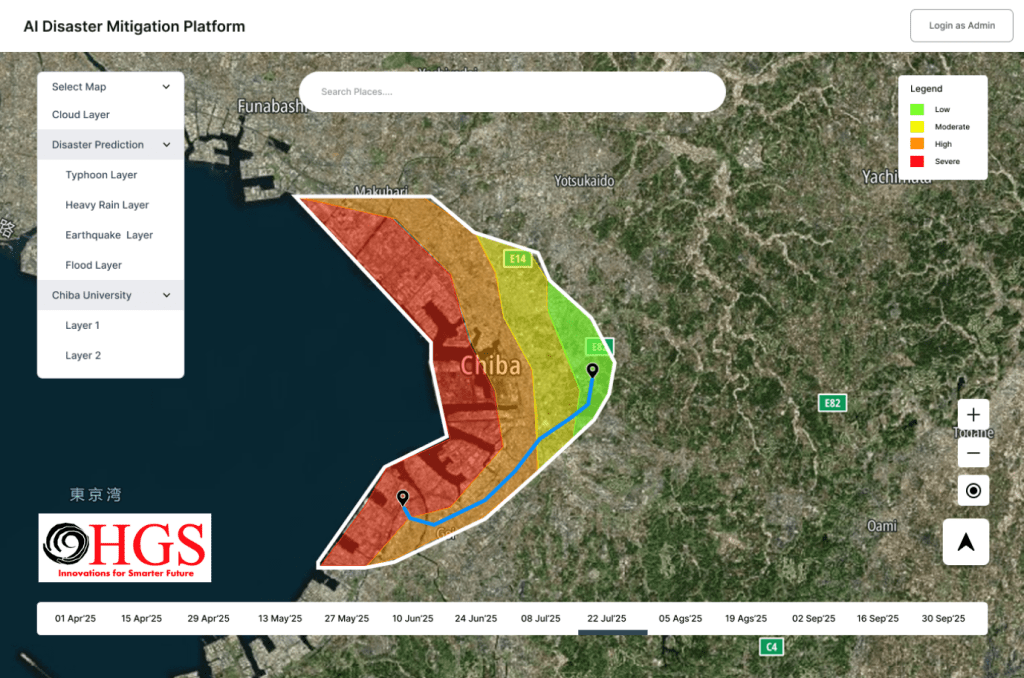
User Interface Design
Implementation
The completed platform will deliver a platform for disaster-related mapping, automatically producing hazard zone maps from AI analysis while also enabling stakeholders to upload their own verified maps. This combination ensures that decision-makers, responders, and communities have timely, accurate, and relevant information in one place during emergencies.
About Institute for Advanced Academic Research (IAAR) Chiba University and Establishment of an Interdisciplinary Hub for AI Disaster Mitigation and Sustainability
Chiba University established the Institute for Advanced Academic Research (IAAR), a hub to generate advanced and innovative research, based on the Chiba University Aspirations. IAAR selects and supports cutting-edge research from each field to develop world-class research. The program also fosters young and mid-career researchers to deliver their full potential.
Recent disasters such as the 2019 Typhoon Faxai and the 2024 Noto Peninsula Earthquake revealed critical gaps in local information after events, hindering medical response and emergency activities. With concerns over future large-scale typhoons, Tonankai Earthquakes, and metropolitan earthquakes, Prof. Josaphat Tetuko Sri Sumantyo established research for an Interdisciplinary Hub for AI Disaster Mitigation and Sustainability.
This program aims to develop sustainable AI disaster mitigation science by leveraging satellite big data and spatial AI through multidisciplinary collaboration involving remote sensing, data science, disaster prevention, meteorology, geophysics, disaster medicine, social sciences, and on-site response.
By integrating scientific disaster prediction and diagnosis with social science decision-making, the program seeks to establish effective disaster crisis response measures and management technologies as a new academic field. It envisions a platform that provides disaster predictions before events, real-time monitoring during crises, situational awareness within 24 hours after disasters, and supports post-disaster reconstruction and emergency medical care. Ultimately, it aims to advance disaster-resilient city and town development using digital twin disaster response science.
Media Contact
Email: info@herdento.com
 Herdento Global Solutions